Back to top

Silenced Stories: Living Voices from the Rubber Boom Era

The so-called Rubber Boom era constitutes a historical period spanning more than threedecades, beginning in 1879, during which the expansion of the rubber industry wassustained by the systematic exploitation of the indigenous peoples of the Amazon,leading to processes of enslavement, structural violence, and the genocide of numerousindigenous peoples. For many families and communities, the memory […]

Ler MAis

Sowing in Ruins: The Irregular Anthropocene in Napo

This talk examines food forests in the Kichwa community of Mulchi Yaku (Napo) as practices of sowing in the ruins of Amazonian extractivism. From the perspective of an irregular and fragmented Anthropocene, it argues that these agroforestry assemblages constitute community-based responses that regenerate soils, knowledge, and multispecies relations. In the face of mining, industrial fish […]

Ler MAis

30 days of resistance: Tapajós River peoples against the privatization of Amazonian rivers and the limits of media coverage

Since January 2026, peoples of the Tapajós River, including Indigenous and riverine communities, in articulation with civil society organizations and socio-environmental movements, have mobilized against Decree No. 12.600/2025, which included more than 3,000 kilometers of Amazonian rivers — such as the Tapajós, Madeira, and Tocantins — in the National Privatization Program, opening the way for […]

Ler MAis

Water Cultures in the Portuguese-Speaking World

This event brings together researchers from various international institutions to discuss the multifaceted relationships between water, culture, and society in the Portuguese-speaking world. Through approaches drawn from environmental humanities, history, literature, and cultural studies, participants explore how rivers, oceans, and aquatic landscapes have shaped social practices, cultural imaginaries, and forms of knowledge in different contexts […]

Ler MAis

Extractive Ecologies: Multispecies Worlds and the Colonial Making of the Amazon

This colloquium explores how colonial and contemporary extractivism has shaped the Amazon as a deeply entangled multispecies world of humans, animals, plants, and other beings. It draws on perspectives from environmental history, political ecology, and ethnography to reflect on both the lasting impacts of colonial extraction and emerging possibilities for more just and sustainable ways […]

Ler MAis

Utopias and Dystopias

Discussion on the notion of environmental utopias and dystopias, which will begin with a brief presentation by the session coordinators, followed by a debate. Coordination: Ananda Carvalho and Joana Sousa February 26, 2:00 p.m., CES Alta | Room 2 In collaboration with ECOSOC – Oficina de Ecologia e Sociedade

Ler MAis

Amazonian Indigenous Women’s Poetry and Art

The talk starts by contrasting the extractivist view of the Amazon, according to which the region is a collection of monetizable resources, and the approach to the territory as a living forest, espoused by Indigenous and other traditional Amazonian communities. It subsequently focuses on the Indigenous understanding of life in Amazonia as a process of […]

Ler MAis

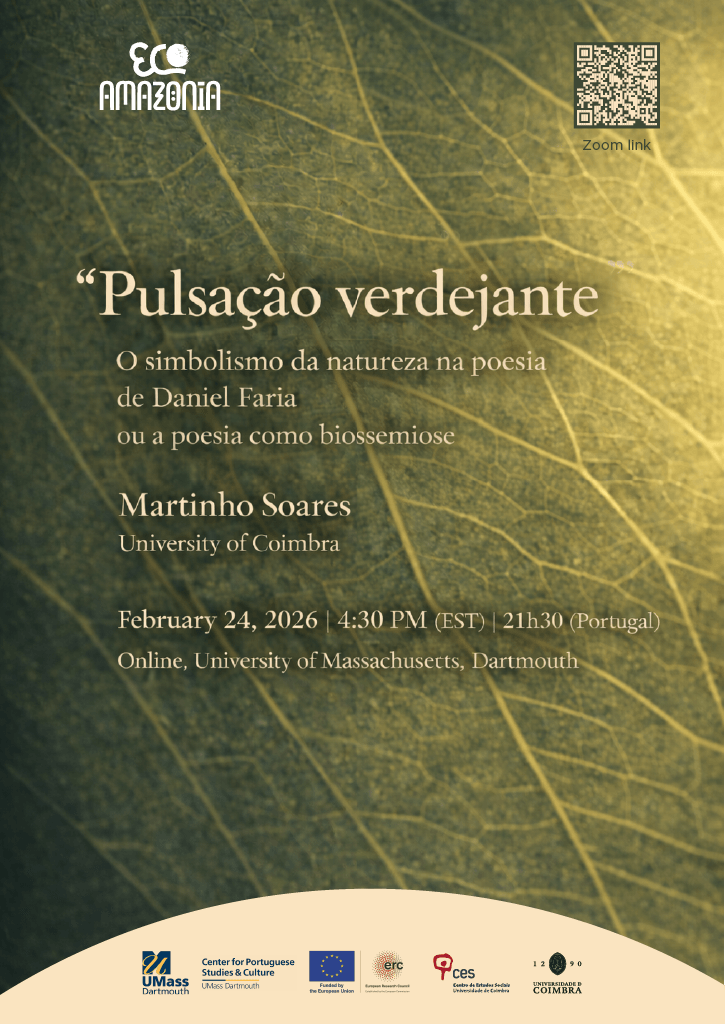
“Verdant Pulsation”: The Symbolism of Nature in the Poetry of Daniel Faria, or Poetry as Biosemiosis

This lecture analyzes the symbolism of nature in the poetry of Daniel Faria through the lenses of the environmental humanities and ecocriticism, situating his work within a critical movement that problematizes traditional dichotomies between nature and culture, human and non-human, visible and invisible. From a non-anthropocentric perspective, the talk argues that, although Daniel Faria’s poetry […]

Ler MAis