
Books / Edited Journal Issues / Articles and Book Chapters / Other Publications
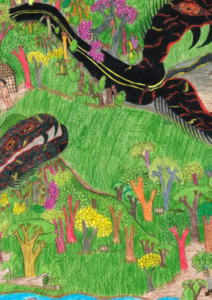
This dossier takes the notion of the future as its point of departure, interrogating it through a plurality of theoretical and methodological approaches that situate the Amazon and its inhabitants—both human and nonhuman—as a privileged political and speculative horizon. To confront the Anthropocene and the risks it poses to planetary habitability demands the elaboration of renewed conceptual apparatuses, insofar as the environmental crisis may be understood simultaneously as a crisis of Western imaginaries—of their institutional formations, epistemological frameworks, and modern political ontologies.
Emanuele Fabiano and Óscar Muñoz Morán (eds.), Dossier: Cuerpos de agua. Revista Kawsaypacha: Sociedad Y Medio Ambiente, (17), 2026.
Drawing on experiences from Latin America, the dossier in the journal *Kawsaypacha: Society and Environment* invites readers to rethink water beyond its status as a resource, positioning it as the cornerstone of social, spiritual, and ecological relationships. This approach opens up new possibilities for the design of more inclusive and culturally grounded environmental policies.

Patrícia Vieira, ed. “Plant Poesis: Aesthetics, Philosophy and Indigenous Thought.” Special Issue of Philosophies. 2025.
This special issue brings together articles that consider various forms of creation together with vegetal life. The essays examine literature, cinema and artworks that foreground plants, as well as reflections on plant interactions with human and other forms of existence. By encouraging a dialogue between views on vegetal life hailing both from philosophy and from other traditions of thought, the articles contribute to the process of decolonizing plant studies and the environmental humanities.

Patrícia Vieira, ed. Special Issue “The Amazon River Basin: Extractivism, Aesthetics and Indigenous Perspectives.” Journal of Latin American Cultural Studies. 32.2 (2023).
The essays in this special issue analyze novels, essays, travel narratives, letters, film, photography and artworks that reveal the preponderance of an extractivist mindset in the approach to Amazonia and its peoples in recent history. The essays also showcase the creative ways in which Amazonian human and more-than-human communities forge counternarratives that underline their affective ties to the land.
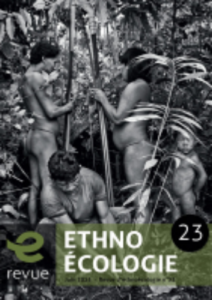
Karen Shiratori, Laure Emperaire and Ana Gabriela Morim de Lima, eds. Special Issue “Voix de la terre”. Revue d’ethnoécologie. 23 (2023).
Through an interdisciplinary approach, this publication encourages exchanges between archaeology, archaeobotany, botany, agronomy and social anthropology, with different theoretical and methodological perspectives on plants with underground starchy reserves. Due to the diversity of the approaches proposed, the fields studied (Europe, Africa and South America) and the times mobilized, it also aims to reflect on plant-society connections in the context of a crisis that makes us reconsider relations between humans and non-humans, even the least visible of the latter, hidden beneath the ground.

This dossier brings together recent contributions focused on the lowlands of South America with the aim of highlighting the theme of dream activity in its relationship with Indigenous cosmopolitics (and by cosmopolitics we mean the process of composing people, collectives and worlds). In common, these works reflect on dreams as events full of consequences, not restricted to nightlife.