
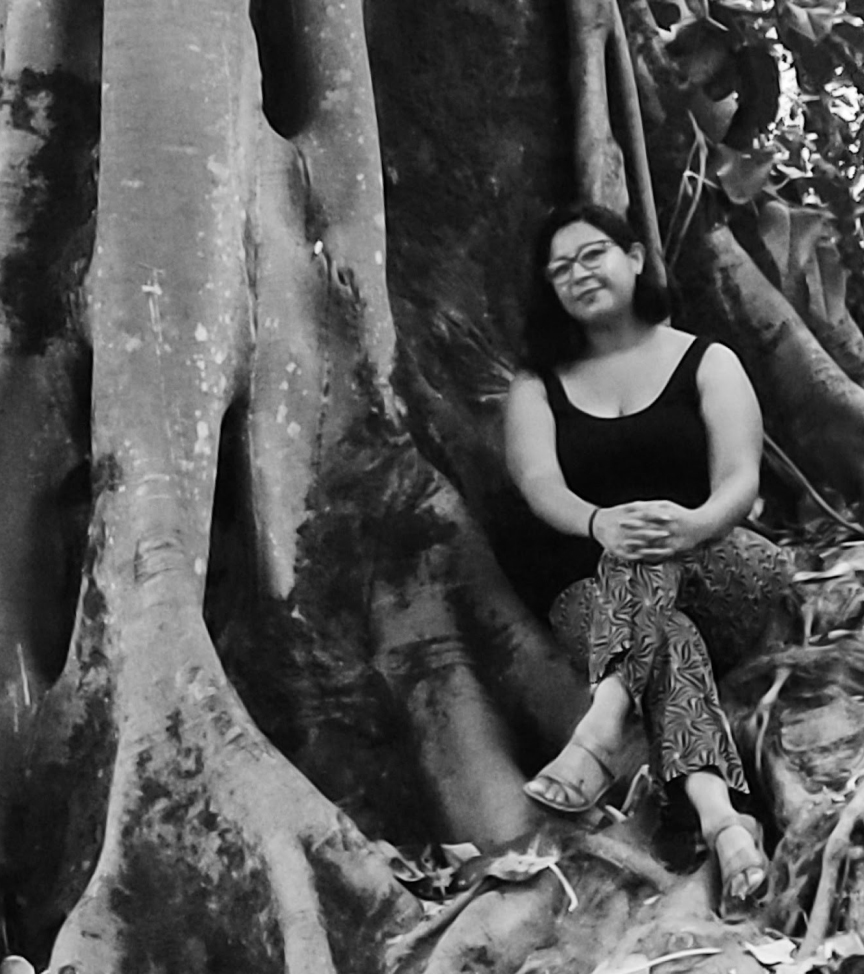
Elena Gálvez
DOCTORAL RESEARCHER
Elena Gálvez holds a PhD in History from FLACSO Ecuador, is a PhD candidate in Philosophy at the University of Coimbra, and has a Master’s degree in Sociology and a BA in History from UNAM. Her academic trajectory unfolds at the intersection of history, philosophy, and sociology, with an interdisciplinary approach and an active commitment to environmentalism and civilizational critique.
She is currently part of the research project ECO: Animals and Plants in the Cultural Productions of the Amazon River Basin, based at the Centre for Social Studies of the University of Coimbra and funded by the European Research Council (ERC). Within this framework, she weaves together historical research, philosophical reflection, and visual practices in dialogue with the environmental humanities—opening pathways that connect knowledge, territories, and forms of sensitivity.
Her work engages deeply with critiques of Eurocentrism, anthropocentrism, and the epistemic frameworks that underpin dominant historiography. From political, ethical, and historical perspectives, she explores alternative ways of narrating what was—and what could have been—disrupting conventional academic registers to make room for other modes of memory, perception, and presence.
Elena investigates nonconventional forms of historical writing that recognize more-than-human sociality. Her research focuses on the relationships among humans, plants, territories, and materialities, particularly within Indigenous contexts in Mesoamerica and the Amazon. In her work, images and photography are not merely sources—they are living archives, capable of revealing power relations, extractive violence, and displaced memories.
Her research is grounded in a decolonial imagination, where history, philosophy, political ecology, and art intertwine as insurgent practices. Alongside her academic work, Elena is also a mother—a dimension that does not stand apart from her scholarship but is woven into the heart of how she researches, writes, and inhabits knowledge.